
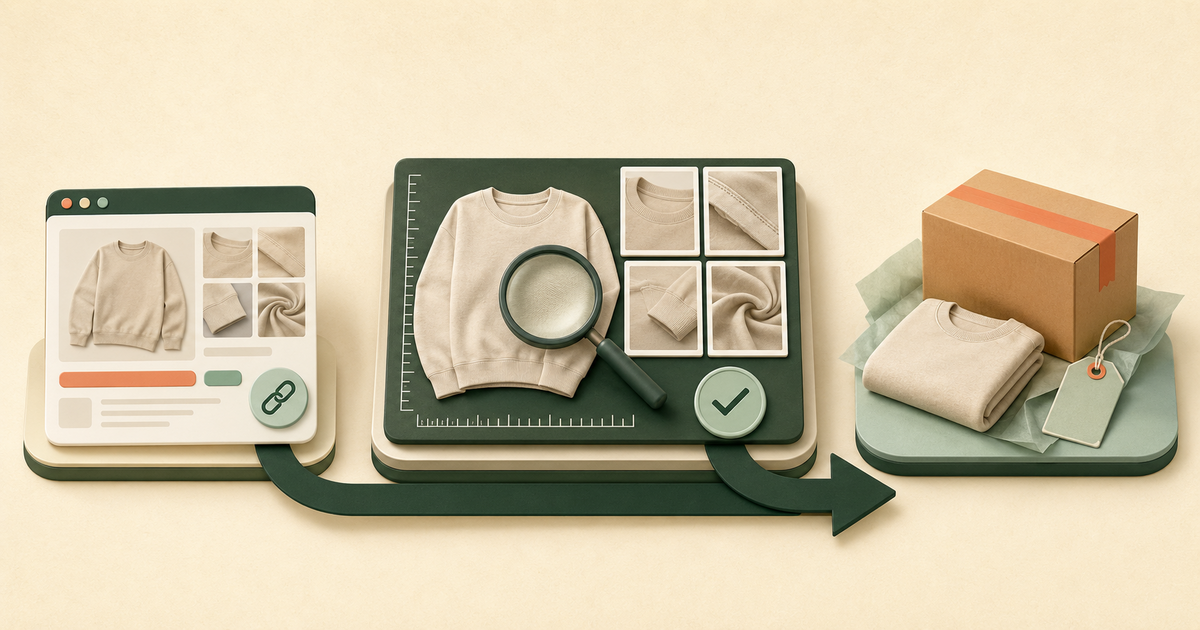
A useful Hubbuy budget find fits your purpose, has a traceable current listing and leaves enough money for the rest of the buying process. The lowest catalogue price does not necessarily produce the lowest delivered cost. Start with one use case, compare a small shortlist and reserve the shipping budget before paying for products. This guide uses a fictional basket to show the decisions, not a list of supposedly tested bargains.
Define the purchase before browsing
Write down what you actually need: for example, a daily T-shirt, a warm layer, a pair of casual shoes or an accessory with a specific size. Add the features that would make the purchase worthwhile and the defects that would make you reject it. This gives you a way to compare listings beyond their pictures. Set a total spending limit in the currency you use for your own budget.
Separate essential items from optional additions. A second cheap item still consumes money, packaging space and review time. If you are learning the buying process, your first order can be a controlled trial rather than a large haul. The aim is to answer questions about selection, sizing and handling while limiting how much money depends on assumptions.
Use categories to create a short, comparable list
Start in the clothing, shoes or accessories category linked below. Search a product name, a model description or an original product ID when you have one. Use image search as a discovery aid if the item is easier to recognise visually. Then open the actual product record. Similar photographs or repeated titles do not establish that two links describe identical goods.
Keep three candidates at most for your first comparison. Record the original source link or ID, seller, exact option, current currency and price, and the date checked. Note any missing information. A comparison is stronger when you can explain what makes one candidate suitable than when you collect dozens of links with no decision criteria.
Compare the selected option, not the headline price
A listing may contain several models, sizes, materials or quantities. Its lowest displayed price can belong to an option you do not want. Choose the intended variant and inspect the amount shown for that selection. Confirm whether the quantity means one piece, one pair or a set. Save the option text and a screenshot before moving to checkout.
For clothing, compare measurements from the exact listing with a garment that fits you. For shoes, distinguish foot, insole and outsole measurements. For accessories, check dimensions, included parts and the stated material. An attractive picture is not evidence of those details. If an essential field is unclear, resolve it or choose a better documented candidate.
Make a budget with separate cost rows
Use separate rows for products, China domestic delivery, any current payment or optional-service charges, packaging, international shipping and possible destination charges. Mark each row as confirmed, estimated or unknown. The public Hubbuy workflow separates the product purchase from the later international shipment, so paying for goods does not complete the delivered-cost calculation.
Do not turn a displayed reference currency conversion into a promise about your final card debit. Keep the original amount and currency, your planning conversion and the eventual payment record distinct. For taxes or import charges, consult the current official guidance for the destination and the applicable shipment. This article does not supply a universal tax percentage.
Walk through a fictional basket
Imagine you need a T-shirt and a hoodie, and notice an inexpensive accessory while browsing. The T-shirt has a clear size chart. The hoodie has an unclear chest measurement and no packed dimensions. The accessory would require an additional seller order. At this stage, none of the three catalogue prices establishes what the complete shipment will cost.
Your first decision is to resolve the hoodie measurement, not to add more goods. Next, estimate a permitted parcel containing the two needed items. Then compare the same plan with the optional accessory, including any additional domestic delivery and packing effect. If the accessory increases the delivered total beyond your limit, its low product price does not make it a good budget choice.
Use shipping scenarios before expanding the basket
Run a plausible package scenario in the official shipping calculator and save the inputs. Product weights before arrival are provisional; final packaging can change weight and volume. Compare a small first order with a larger combined order only if each uses realistic goods, destination and packaging assumptions. Read route restrictions before relying on a quoted service.
A cheaper average per item is not the same as a cheaper order. Spending more money to spread shipping across unwanted products defeats the budget. Likewise, splitting everything into separate parcels may repeat charges. Choose the smallest eligible plan that meets your actual needs, and revisit the comparison when measured warehouse information becomes available.
Check seller uncertainty before paying
Read any current dispatch information, option availability and after-sales conditions shown for the listing or order. If timing matters, ask a concrete question about the selected item rather than treating a generic platform statement as a seller promise. Keep the response with your order notes. A cheap product that cannot arrive in time may not meet your purpose.
When a link no longer works, return to the original ID and listing. Do not silently replace it with a similar picture from an unknown seller. Recheck the option, dimensions and price for any replacement. There is no universal approval badge in this article, and inclusion in an independent spreadsheet does not certify a seller or the authenticity of goods.
Use warehouse QC to protect the remaining budget
When the order arrives, compare the received item with the saved variant and the measurements that mattered to your decision. Review clear views of labels, quantity, shape and visible condition. Request a specific missing measurement or view when the current service permits it and the answer could change your decision. Check any additional charge before requesting work.
If the wrong size, colour or quantity arrived, document the mismatch and check the current return or handling options promptly. Keep uncertain goods out of a parcel until you understand the next step. International shipment adds cost and changes the practical situation; it should not become a reason to ignore a problem discovered while the item is still in the warehouse.
Decide whether to combine or wait
Combining compatible orders can reduce repeated parcel overhead, but waiting for one seller can delay everything else. Make a list of ready, unresolved and not-yet-arrived items. Compare the cost and usefulness of shipping ready goods with waiting for the rest. Check each order’s storage and handling dates in the current account rather than assuming all items share the same deadline.
Do not treat the advertised storage allowance as a return window. Those are different questions. Keep dates, evidence and support responses attached to each order. If an optional item creates a restriction or an uncertain wait, a smaller completed purchase may be more useful than a larger parcel that never becomes ready.
Keep a purchase record and improve the next order
After delivery, compare your budget with actual debits and write down what caused any difference. Record fit, useful measurements, packing choices and whether the item met its intended use. Separate first-hand observations from what the listing claimed. A good experience with one option does not establish that a changed listing or another model is equivalent.
For the next order, reuse the comparison process and update the live facts. Your useful shortlist is the one with traceable links, understandable options and a realistic delivered-cost range. Browse the categories for ideas, use the calculator for planning, and keep the final purchase decision tied to the exact item and current conditions.