
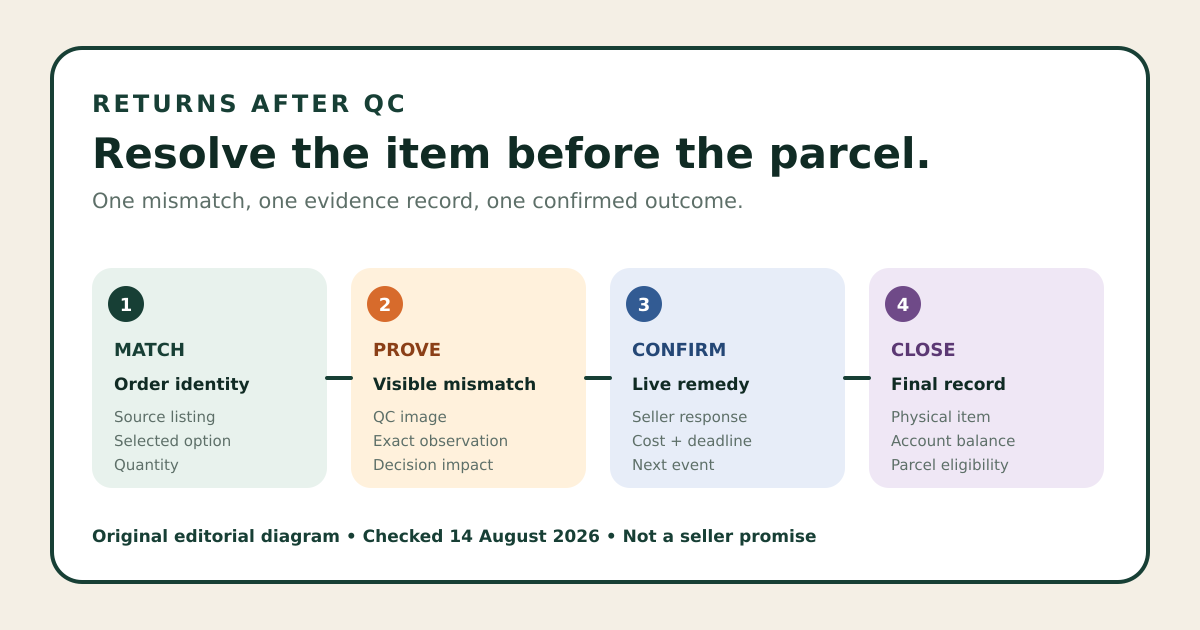
A Hubbuy refund may involve a decision about the product, return processing, a credit to the account, and money moving through the payment method. These records do not mean the same thing. To track a case, first identify the verified stage and corresponding amount. This guide organizes the documents and practical checks; conditions, eligibility, fees, and timelines must be confirmed for the current order.
Identify whether the problem concerns the item or the parcel
Before opening a request, record exactly what happened. A product in the wrong color, an incorrectly selected size, a visible defect, and an undelivered international parcel are different situations. A problem noticed in the warehouse should be linked to the item order. A problem after dispatch also requires the parcel number, route, and transport history.
The public service description separates purchasing, inspection, storage, and international transport. Use that distinction to organize your case, without assuming one rule resolves every stage. Hubbuy Sheet publishes guidance and references; it cannot access accounts, decide returns, or receive order payments. Purchase issues must be handled through the channel associated with the transaction.
Compare what arrived with the option actually purchased
Open the saved listing and order summary. Check the model, color, size, quantity, and accessories described for the selected option. Catalogue photos may show several versions, while the order corresponds to only one. Write down the variant name and item identifier; this avoids basing a complaint solely on a similar-looking thumbnail.
Then choose the QC photo that demonstrates the discrepancy. A label may confirm the marked size, but it does not prove the internal shoe measurement on its own. For clothing, a well-positioned ruler can clarify a size difference. Separate what the image shows from what still requires measurement or assessment. A precise account makes a response easier without demanding conclusions the photo cannot support.
Check the conditions before including the item in a shipment
Check the current return or exchange option and retain the conditions shown for that order. Record whether there is a deadline, which event starts it, who needs to respond, and whether labels or packaging are required. Do not treat the storage period as a return deadline: these are different matters and may depend on different rules.
While a request is under review, confirm the effect of approving the item, consolidating products, or submitting the parcel. Do not assume an action can be undone after international dispatch. If the interface does not explain the consequence, request an answer referring to the order number before taking an action that could change the goods' situation.
Prepare a small set of useful evidence
Create a record with the order number, warehouse identifier, original link, paid variant, problem description, and selected photos. Include the listing image only when it demonstrates a promised characteristic. A short sequence with clear captions is usually easier to interpret than dozens of screenshots without context. Keep the original files for any later comparison.
State the requested outcome concretely: check a measurement, exchange an incorrect unit, or assess a return. Avoid mixing problems from several orders in the same description. Personal information and complete receipts should be sent only through the appropriate purchase channel. A public post about the case does not need to expose an address, identity document, password, or full payment identifier.
Compare exchange and return options by their overall outcome
An exchange may involve a return to the seller, another domestic shipment, and a new warehouse check. A return may produce an amount different from the total originally paid, depending on the applicable conditions. Before accepting, request an itemized breakdown: product, domestic shipping, service, packaging, and any stated deduction. Do not treat someone else's fee as the rule for your order.
Also consider your original goal. If the date of use matters, repeating the purchase and QC cycle may no longer make sense. If the problem is an incompatible measurement, ordering the same size again does not address the cause. Use a written comparison of the expected result, confirmed cost, and outstanding information to choose how to proceed.
Track approval, credit, and receipt separately
Record three financial milestones: the refund decision, the credit entry, and receipt at the stated destination. A message saying the request was accepted is not the same as a final posted transaction. Similarly, a balance available within a platform should not be confused with money credited to the card or bank account originally used.
If the interface shows a withdrawal or refund to a payment method, keep the amount, currency, date, and transaction reference. Check whether this processing has its own identifier. If the button does not appear, do not conclude that the money is lost or that it has already been transferred. Ask for clarification of the actual status and the next step available for that balance.
Reconcile the refund without confusing exchange rates and processing stages
Compare the approved amount in the same currency as the return record. Then compare the amount received through the payment method, noting the currency and conversion information actually provided. Keep pending amounts and settled amounts on separate lines. Do not add an internal credit and a transfer as though they were two refunds when they represent the same return at consecutive stages.
Fictional example: the order records 100 monetary units for the product and a separate shipping charge of 10. An approval for 100 alone does not explain what happened to the other 10. The correct step is to request a breakdown, not to claim money is missing without checking the conditions. This example explains the checking method; it does not represent a Hubbuy fee or policy.
Use a timeline to request updates
Note the date you identified the problem, the first request, the response received, the physical return where applicable, and each financial change. When asking for an update, cite the last verified milestone and the next one still missing. If customer service supplies a timeframe, save the message and the condition that starts it to avoid incorrect comparisons.
If the record says a transfer occurred but it does not appear at the destination, collect the processing reference and corresponding receipt. Request a check that connects both ends. Avoid creating several disconnected requests about the same amount, as this makes the history harder to follow. No timeframe found in a public account replaces information confirmed for your own transaction.
Close the case with evidence of the outcome
Check that the item's final status matches what was agreed and that the financial entry is identified. For an exchange, review the new QC before accepting the unit. For a return, keep the receipt or processing confirmation and the reconciled amount. Closing the case should record the actual resolution, not merely the last customer-service message.
For the next purchase, keep the measurement chart, chosen variant, and relevant conditions before payment. These records make later comparisons much simpler. The best prevention is to reduce ambiguity in the order and review the goods while they are still at the appropriate stage. When information is insufficient, state the uncertainty explicitly and seek confirmation before the next commitment.
HubbuyCN's public purchasing, inspection, consolidation, and calculator workflows were consulted on 1 October 2026. Measurement and calculation examples are illustrative. Order rules, services, amounts, and timelines must be confirmed in the active interface; this independent guide does not represent the platform's customer service.
Continue researching your product
Find a catalogue reference and confirm the listing, variant, and price on the current page.